


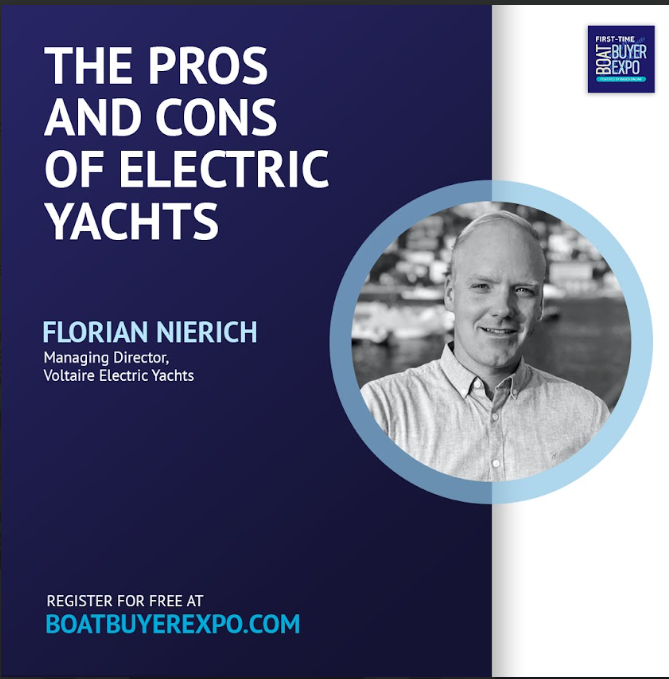

In this blog post, we had the pleasure of talking to Florian, the passionate founder of Voltaire Yachts. Florian's mission is clear: he's on a mission to completely transform the marine leisure industry and make it carbon-neutral.
He's had a love for boating from an early age, and he believes that there's nothing quite like the feeling of being out on the water. His dedication to this cause is not only remarkable but also incredibly inspiring. It's his unwavering love for the water that has pushed him to create a more sustainable and eco-friendly future for everyone who enjoys marine leisure activities.
Do you know traditional boats powered by internal combustion engines are significant contributors to greenhouse gas emissions.
According to the International Council of Marine Industry Associations (ICOMIA), recreational boats can emit as much as 25 times the carbon emissions of an average car per gallon of fuel consumed.
Moreover, gasoline and diesel-powered boats release harmful substances into the water, including oil, fuel, and heavy metals. These pollutants can harm marine ecosystems and disrupt aquatic life.
As you know, our planet is at a crossroads, facing a pressing need to reduce emissions and mitigate the effects of climate change.
In this critical moment, the rise of electric boats is a beacon of hope, offering a sustainable and eco-friendly alternative to traditional watercraft.
In this blog post, we had the pleasure of talking to Florian, the passionate founder of Voltaire Yachts. Florian's mission is clear: he's on a mission to completely transform the marine leisure industry and make it carbon-neutral.
He's had a love for boating from an early age, and he believes that there's nothing quite like the feeling of being out on the water. His dedication to this cause is not only remarkable but also incredibly inspiring. It's his unwavering love for the water that has pushed him to create a more sustainable and eco-friendly future for everyone who enjoys marine leisure activities.
So, let's get started!
Dione: What are electric yachts and how are they different from regular yachts or Powerboats?
Florian: We can also consider the difference from an automotive perspective. What sets apart a diesel or petrol-powered boat from an electric one?
Over the past century, the yachting world has heavily relied on automotive technologies, leading to the development of specialized marine automotive engines.
Today, we continue to incorporate various automotive technologies into yacht designs. As the changes we see on the streets make their way to the yachting world, the simplest explanation is this: an electric yacht is similar to an electric car. It's essentially a boat with an electric engine. To put it in general terms, it's a battery-electric-powered yacht, equipped with an electric engine and a battery that supplies the necessary electricity to power the engine.
Dione: What is driving this interest by the manufacturer and inventors, I suppose, to suddenly be putting these product launches into the market?
Florian: We currently do not have a serial production company for electric vehicles in the yachting sector, so this is truly a pioneering field where new companies with fresh ideas want to enter the market with an all-electric product. Basically, like Tesla, everybody laughed about Tesla back then.
They're pioneers entering this market. Today, we know where Tesla is, and it's the same with many electric companies that are starting now. They're moving into the market, and they will eventually grow bigger and establish themselves. This market is on the move now. It's very volatile and also very exciting because I think that after a few years, we will see which concept works and which companies have the best ideas, and then they will grow bigger and become the first serial production yacht for electric boats.
Dione: Is most of this innovation coming from niche start-up companies like your
company or is it coming from the production factories that are doing a little bit of this on the side? Tell us a little bit about that.
Florian: You know, it's really interesting because it's kind of like what's happening in the automobile market. You've got these big players like GM, Volkswagen, and Toyota, sitting on piles of money, but they haven't really put a lot into electric vehicle research and development lately. They seem pretty comfortable with their current product lines, thinking, "Let's just stick with what we've got for now."
And it's a similar story in the yachting industry. The established shipyards are doing well, and everything's business as usual. They don't really see a pressing need to dive into the electric yacht market. Unlike the automotive giants, shipyards don't have endless resources for research and development. So, the small companies are taking the lead here.
We're essentially starting from scratch and trying a fresh approach. Electric boating requires a different boat concept, and most of the boats on the market right now, your regular production yachts, aren't very compatible with electric engines. So, it's not just about making electric yachts; it's about changing the whole company concept. The big players are a bit hesitant. I believe that when they see these smaller companies making waves, they'll eventually change their tune, but that's probably at least five years down the road. So, for now, it's a playing field for the newbies in the market.
Dione: Are there any other alternative power sources for boats aside from electric, or are we primarily considering diesel, petrol engines, and electric as the main options? Is there another alternative?
Florian: When talking about boats, obviously, there are two sides. We have the sailing
boats and we have the power boat. Sailboats rely on their sails, using the engine only when there's no wind or for maneuvering. Sailing is the oldest form of boating and is still quite popular today with many sailboats in use. On the other hand, the number of powerboats is on the rise because they offer more comfort and flexibility. However, when it comes to alternatives to diesel and petrol, electric is currently the only relevant power storage alternative available.
Dione: What are the pros and cons of electric versus the original?
Florian: The biggest pro is that it is the most future-oriented choice that you can make. If you’re now buying a brand new boat with a diesel engine, you’re basically buying a dinosaur which maybe nobody wants to have in 10 years anymore.
With electric boats you can always be sure that you will have a good resale value because nobody knows what’s happening. The governments are very active now and if they decide in the future, maybe 10 years from now, to close off some areas for diesel or petrol boats, then you have a problem and your boat is losing value because you have an old technology boat. Going electric is really a choice for the future.
Also you have all these pros of electric propulsion, you have low noise, and you have low maintenance. With low noise, if you think about it, everybody who knows motor yachts knows how it is to drive on a motor yacht, you have to scream to each other and everybody is happy when the engine is off. Of course there are cons on the other side. The biggest con is the performance.
Electric boats do have lower performance than diesel-powered boats. They have a lower range.
They tend to have lower speeds. So with a diesel boat, maybe 45-foot, I can go 40 knots for 100 nautical miles. I can go full speed for 200 nautical miles, no problem. In the end, of course, maybe I have to re-tank 2,000 litres of diesel. With electric boats, at this point in time, it is not possible yet.
Another con is the price. Electric boats are a bit more pricey. The main reason is not really that the electric propulsion is more expensive. The main reason is that there is no production yard that produces electric boats in bulk yet. If we see one of the major production yards produce an electric boat, maybe 100 of them a year, then we would see a price drop. They could produce at a reasonable price. The electric boats that are available now in the market are more custom-built and therefore more expensive.
Dione: How long does the battery last? Is that a con or is that technology getting super good now?
Florian: That’s going into the performance area, so it’s really all about where does your
energy comes from. You know that the engine size on an electric boat can scale it up. It can be a 100 kilowatt, it can be a 200 kilowatt engine, but where does the energy come from?
For choices, you can get the energy from batteries, from solar, from a diesel generator, or you can get it from hydrogen fuel cells. Usually, all the electric boats on the market now you’re getting the energy from a battery and you can maybe top it up by solar or by diesel generator, but that is still not enough to kind of get the distances that you can get with a diesel or petrol engine.
The question of how long the battery lasts depends on the customer and the use case of the customer. So what are you looking for? Are you looking for a boat that can cross the Atlantic? That does exist.
There are boats with big solar roofs that can drive for many days without recharging, but at lower speed of course. And you also have smaller boats that can go full speed where the battery only lasts for an hour or half an hour. We have the full spectrum of all the possibilities. It really depends on the use case and the customer.
Dione: There are some good guarantees on battery life these days, isn’t there, with the advances in technology, hasn’t it?
Florian: This is interesting. Just like in the automotive industry, the battery is the interesting part of every electric boat. In our company we have a Torqeedo BMW battery that offers a 9-year warranty capacity. There are also other producers who have different battery systems.
Dione: Can you explain a little bit about the parts that you are using because with this new technology in new building boats, are you inventing stuff or are you using parts that are already out there that are already tried and tested?
Florian: Like every other shipyard, we are buying complete systems for our boats because shipyards usually are not companies that build engines. A normal shipyard also wouldn’t build a diesel engine. We are boat builders and we choose the best system that fits best to our boat.
This is very beneficial for us and for the customer because we have chosen Torqeedo which is the market leader in the world. If you buy our boat you’d get a Torqeedo system. They have a worldwide service.
If you have any question or you want to add something to your system, you just go to your local dealer anywhere in the world and talk to them about it. That is good for us because we don’t have to build the system ourselves, but also for the customer because he gets a very reliable system, a system that’s proven in the market and he gets the service which is the most important part.
Dione: You talked briefly about the maintenance of electric yachts. I heard that the maintenance is cheaper and actually, I might even be able to do the maintenance myself. What’s your thoughts and feedback on that?
Florian: If you talk about first time boaters, I think electric boats are something very
interesting to look into because the maintenance is much lower. With the diesel engine, there are so many things that you have to consider on a diesel engine. Before you get out on the water you check your engine, the diesel filter, the oil and all these things. With an electric boat, you just go on board, you turn on the boat and you put the throttle down and you drive. There is nothing to check.
What you said about working on it yourself is a bit more tricky. If you have a high-voltage system--and most of the electric boats do have a high-voltage system--you should not approach that yourself. There’s the cooling system that needs maintenance which you can do by yourself but in general, there’s very, very low maintenance.
Dione: Are electric engines more simple than petrol and diesel engines? Is that what we’re saying?
Florian: Yes, and this is good. The more simple an engine is, the less likely it is to break
down. If you look at diesel engines for boats, especially for sailing boats, they are very, very simple. This is very old technology and this is for a reason because simple also means that the likelihood of failure is very low and nobody wants failure on the water.
And so, everybody tries to keep the engine as simple as possible. With the electric engine, the motor itself, it has been in trains for more than a hundred years. Electric motors are the most
sturdy engines that you can have in the world. It’s just a very simple system with just one part that moves. It’s not a whole engine that is shaking. Diesel engines have so many parts that are moving constantly and everything that moves breaks. If you have a stable system, you’re more likely to have fewer problems on the sea.
Dione: Are there any second-hand electric boats on the market yet or are we still in the early days and if you want an electric boat you will have to buy a new one?
Florian: Yeah. I think we are really in the early days. We will have to wait years for second-hand boats to be available on the market.
Dione: I had a guy ask me and he has this concept in his mind that he wanted to
repower a boat that he bought with electric. Is that feasible or not?
Florian: No, I would say not. If you have a diesel engine and it runs, let it run. If you are a
new boat, buy electric. Most of the boats that have been designed for diesel engines are very heavy, they have a short water line and they have a high volume, and so it doesn’t really make sense to put an electric engine in this kind of boat because these boats need a lot of energy.
They were built with the idea of having 1,000-2,000 horsepower engines and if you would put an engine with a lower horsepower, then the boat wouldn't work. I think sailing boats, yes, because sailing boats tend to live longer so you can always re-equip your sailing boat with an electric engine. With a power boat, it really has to depend on the power boat, but usually not.
Dione: So just explain to us some examples of what you’re building and how big
it is. So you’re building a catamaran at the moment, so just explain a couple of
your boat so we understand what these electric boats look like.
Florian: With our brand Voltaire, we have a 33 feet long open day boat which can accommodate 12 people and you can drive with it 100 nautical miles. You can even drive fast at 20 knots if you want to, maybe not for five hours but you can drive fast for maybe 45 minutes and you can drive 20 knots. It’s a very open boat so you have one deck.
We’re actually currently working on a cabin model as well but we are looking at this mid-size field, mid-size range for a boat that is easy to manoeuvre for two people or for one person even, where you can host 12 people where you have a big bathroom. You need a big bathroom. You need a wet bar where you can have a fridge and an ice maker so you really just go out and have a good day on the sea and when you come back, you know you went out the whole day and you didn’t hurt the ecosystem at all.
Dione: You’re obviously very passionate about this and you’ve got a vision and you have a mission, can you share with us what that sort of personal “crusade” around the electric project?
Florian: I’ve grown up with boats all my life. It’s not my goal to change the industry but
I want to be part of this change and I do want to change this industry. I want to be one of the
people who drive the change and not to be one that hangs on to the old ways of doing things.
It is my goal to drive fossil-free. We are not really focused on the electric engine. The electric engine is just a means of getting to the goal. The goal is really to be at some point fossil-free on the water and that’s what it’s all about
Note: This interview is being run for the Boat Buyer Expo (www.boatbuyerexpo.com). You can also watch the interview on YouTube HERE.
About Florain: Florian is the founder of Voltaire Yachts and it is his goal to change the marine leisure industry to zero carbon. He has enjoyed boating since an early age and believes there is nothing better than being out on the water.
It is my goal to drive fossil-free. We are not really focused on the electric engine. The electric engine is just a means of getting to the goal. The goal is really to be at some point fossil-free on the water and that’s what it’s all about." ~Florian Nier
Media Gallery